988 Flip Equivalent Binary Trees
988 Flip Equivalent Binary Trees
Flip Equivalent Binary Trees 
For a binary tree T, we can define a flip operation as follows: choose any node, and swap the left and right child subtrees.
A binary tree X is flip equivalent to a binary tree Y if and only if we can make X equal to Y after some number of flip operations.
Given the roots of two binary trees root1 and root2, return true if the two trees are flip equivalent or false otherwise.
Example 1:
1
2
3
4
5

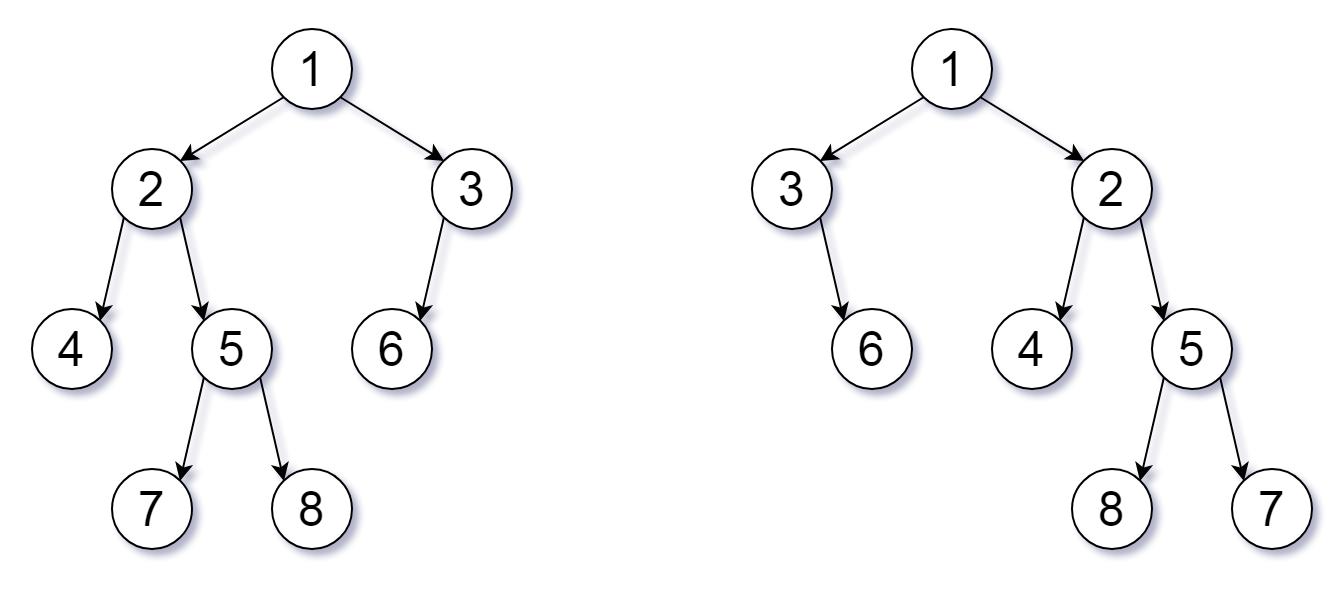
**Input:** root1 = [1,2,3,4,5,6,null,null,null,7,8], root2 = [1,3,2,null,6,4,5,null,null,null,null,8,7]
**Output:** true
**Explanation: **We flipped at nodes with values 1, 3, and 5.
Example 2:
1
2
3
4

**Input:** root1 = [], root2 = []
**Output:** true
Example 3:
1
2
3
4

**Input:** root1 = [], root2 = [1]
**Output:** false
Constraints:
1
2
The number of nodes in each tree is in the range [0, 100].
Each tree will have **unique node values** in the range [0, 99].
1
2
3
4
5
6
7
8
9
10
11
12
13
14
15
16
17
18
19
20
21
22
23
24
25
26
27
28
29
30
31


# Definition for a binary tree node.
# class TreeNode:
#     def __init__(self, val=0, left=None, right=None):
#         self.val = val
#         self.left = left
#         self.right = right
class Solution:
    def flipEquiv(self, root1: Optional[TreeNode], root2: Optional[TreeNode]) -> bool:


        def abc(root1, root2):

            if (root1 == None and root2 != None) or (root1 != None and root2 == None) :
                return False

            if root1 == None and root2 == None:
                return True

            if root1.val != root2.val:
                return False

            return (abc(root1.right, root2.left) and abc(root1.left, root2.right)) or (abc(root1.left, root2.left) and abc(root1.right, root2.right))

        return abc(root1, root2)
This post is licensed under CC BY 4.0 by the author.