2545 Height Of Binary Tree After Subtree Removal Queries
2545 Height Of Binary Tree After Subtree Removal Queries
Height of Binary Tree After Subtree Removal Queries 
You are given the root of a binary tree with n nodes. Each node is assigned a unique value from 1 to n. You are also given an array queries of size m.
You have to perform m independent queries on the tree where in the ith query you do the following:
1
**Remove** the subtree rooted at the node with the value queries[i] from the tree. It is **guaranteed** that queries[i] will **not** be equal to the value of the root.
Return an array *answer of size m where answer[i] is the height of the tree after performing the ith query*.
Note:
1
2
The queries are independent, so the tree returns to its **initial** state after each query.
The height of a tree is the **number of edges in the longest simple path** from the root to some node in the tree.
Example 1:
1
2
3
4
5
6

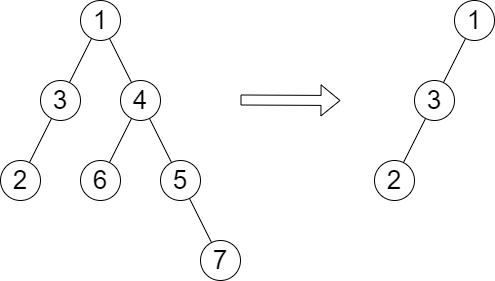
**Input:** root = [1,3,4,2,null,6,5,null,null,null,null,null,7], queries = [4]
**Output:** [2]
**Explanation:** The diagram above shows the tree after removing the subtree rooted at node with value 4.
The height of the tree is 2 (The path 1 -> 3 -> 2).
Example 2:
1
2
3
4
5
6
7
8
9

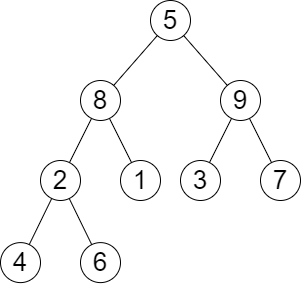
**Input:** root = [5,8,9,2,1,3,7,4,6], queries = [3,2,4,8]
**Output:** [3,2,3,2]
**Explanation:** We have the following queries:
- Removing the subtree rooted at node with value 3. The height of the tree becomes 3 (The path 5 -> 8 -> 2 -> 4).
- Removing the subtree rooted at node with value 2. The height of the tree becomes 2 (The path 5 -> 8 -> 1).
- Removing the subtree rooted at node with value 4. The height of the tree becomes 3 (The path 5 -> 8 -> 2 -> 6).
- Removing the subtree rooted at node with value 8. The height of the tree becomes 2 (The path 5 -> 9 -> 3).
Constraints:
1
2
3
4
5
6
7
8
The number of nodes in the tree is n.
2 <= n <= 105
1 <= Node.val <= n
All the values in the tree are **unique**.
m == queries.length
1 <= m <= min(n, 104)
1 <= queries[i] <= n
queries[i] != root.val
1
2
3
4
5
6
7
8
9
10
11
12
13
14
15
16
17
18
19
20
21
22
23
24
25
26
27
28
29
30
31
32
33
34
35
36
37
38
39
40
41
42
43
44
45
46
47
48
49
50
51
52


class Solution:
    def treeQueries(
        self, root: Optional[TreeNode], queries: List[int]
    ) -> List[int]:
        max_height_after_removal = [0] * 100001
        self.current_max_height = 0

        def _traverse_left_to_right(node, current_height):
            if not node:
                return

            # Store the maximum height if this node were removed
            max_height_after_removal[node.val] = self.current_max_height

            # Update the current maximum height
            self.current_max_height = max(
                self.current_max_height, current_height
            )

            # Traverse left subtree first, then right
            _traverse_left_to_right(node.left, current_height + 1)
            _traverse_left_to_right(node.right, current_height + 1)

        def _traverse_right_to_left(node, current_height):
            if not node:
                return

            # Update the maximum height if this node were removed
            max_height_after_removal[node.val] = max(
                max_height_after_removal[node.val], self.current_max_height
            )

            # Update the current maximum height
            self.current_max_height = max(
                current_height, self.current_max_height
            )

            # Traverse right subtree first, then left
            _traverse_right_to_left(node.right, current_height + 1)
            _traverse_right_to_left(node.left, current_height + 1)

        _traverse_left_to_right(root, 0)
        self.current_max_height = 0  # Reset for the second traversal
        _traverse_right_to_left(root, 0)

        # Process queries and build the result list
        return [max_height_after_removal[q] for q in queries]
This post is licensed under CC BY 4.0 by the author.