684 Redundant Connection
684 Redundant Connection
Redundant Connection 
In this problem, a tree is an undirected graph that is connected and has no cycles.
You are given a graph that started as a tree with n nodes labeled from 1 to n, with one additional edge added. The added edge has two different vertices chosen from 1 to n, and was not an edge that already existed. The graph is represented as an array edges of length n where edges[i] = [ai, bi] indicates that there is an edge between nodes ai and bi in the graph.
Return an edge that can be removed so that the resulting graph is a tree of *n nodes*. If there are multiple answers, return the answer that occurs last in the input.
Example 1:
1
2
3
4

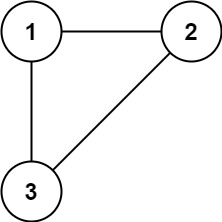
**Input:** edges = [[1,2],[1,3],[2,3]]
**Output:** [2,3]
Example 2:
1
2
3
4

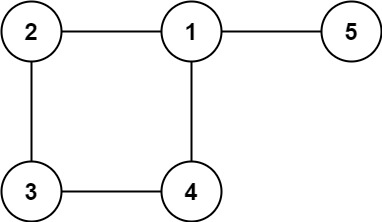
**Input:** edges = [[1,2],[2,3],[3,4],[1,4],[1,5]]
**Output:** [1,4]
Constraints:
1
2
3
4
5
6
7
n == edges.length
3 <= n <= 1000
edges[i].length == 2
1 <= ai < bi <= edges.length
ai != bi
There are no repeated edges.
The given graph is connected.
1
2
3
4
5
6
7
8
9
10
11
12
13
14
15
16
17
18
19
20
21
22
23
24
25
26
27
28
29
30
31
32
33
34
35
36
37
38
39
40
41
42
43
44
45
46
47
48
49
50
51
52
53
54


func dfs(source int, adj map[int][]int , visited map[int]bool, parent int) bool {
    //fmt.Println(visited, source, adj)
    _, ok := visited[source]

    if ok  {

        return false
    }
    visited[source] = true

    for _, k := range adj[source] {
        if parent != k && ! dfs (k, adj, visited, source)  {
            return false
        }
    }
    return true
}

func findRedundantConnection(edges [][]int) []int {

    adj := make(map[int][]int)

    for _, k := range edges {
        _, ok := adj[k[0]]
        if ! ok {
            adj[k[0]] = make([]int, 0)
            adj[k[0]] = append(adj[k[0]], k[1])
        } else {
            adj[k[0]] = append(adj[k[0]], k[1])
        }


        _, ok = adj[k[1]]
        if ! ok {
            adj[k[1]] = make([]int, 0)
            adj[k[1]] = append(adj[k[1]], k[0])
        } else {
            adj[k[1]] = append(adj[k[1]], k[0])
        }

        visited := make(map[int]bool)
        //fmt.Println("andy")
        if ! dfs(k[0], adj, visited, -1) {
            return k
        }
    }

    return nil
}
This post is licensed under CC BY 4.0 by the author.