2764 Maximum Number Of Fish In A Grid
2764 Maximum Number Of Fish In A Grid
Maximum Number of Fish in a Grid 
You are given a 0-indexed 2D matrix grid of size m x n, where (r, c) represents:
1
2
A **land** cell if grid[r][c] = 0, or
A **water** cell containing grid[r][c] fish, if grid[r][c] > 0.
A fisher can start at any water cell (r, c) and can do the following operations any number of times:
1
2
Catch all the fish at cell (r, c), or
Move to any adjacent **water** cell.
Return *the maximum number of fish the fisher can catch if he chooses his starting cell optimally, or *0 if no water cell exists.
An adjacent cell of the cell (r, c), is one of the cells (r, c + 1), (r, c - 1), (r + 1, c) or (r - 1, c) if it exists.
Example 1:
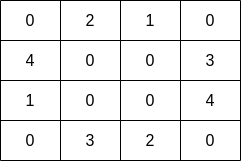
1
2
3
4
5

**Input:** grid = [[0,2,1,0],[4,0,0,3],[1,0,0,4],[0,3,2,0]]
**Output:** 7
**Explanation:** The fisher can start at cell (1,3) and collect 3 fish, then move to cell (2,3) and collect 4 fish.
Example 2:
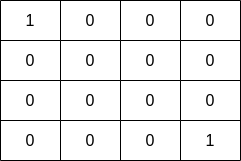
1
2
3
4
5

**Input:** grid = [[1,0,0,0],[0,0,0,0],[0,0,0,0],[0,0,0,1]]
**Output:** 1
**Explanation:** The fisher can start at cells (0,0) or (3,3) and collect a single fish.
Constraints:
1
2
3
4
m == grid.length
n == grid[i].length
1 <= m, n <= 10
0 <= grid[i][j] <= 10
1
2
3
4
5
6
7
8
9
10
11
12
13
14
15
16
17
18
19
20
21
22
23
24
25
26
27
28
29
30
31
32
33


func dfs(i int, j int, grid [][]int) int {
    if (grid)[i][j] == 0 {
        return 0
    }
    res := (grid)[i][j]
    (grid)[i][j] = 0
    dir := [][]int{{1,0}, {0,1}, {-1,0}, {0,-1}}
    for _, k := range dir {
        if k[0] + i >= 0 && k[0] + i < len(grid) && k[1] + j >= 0 && k[1] + j < len((grid)[0]) {
            res += dfs(k[0] + i, k[1] + j, grid)
        }
    }
    return res
}

func findMaxFish(grid [][]int) int {
    res := 0
    for i, _ := range grid {
        for j, k := range grid[i] {
            if k > 0 {
               // fmt.Println(grid, i, j)
                res = max(res,dfs(i, j , grid))
            }
        }
    }
    return res
}
This post is licensed under CC BY 4.0 by the author.