2711 Minimum Time To Visit A Cell In A Grid
2711 Minimum Time To Visit A Cell In A Grid
Minimum Time to Visit a Cell In a Grid 
You are given a m x n matrix grid consisting of non-negative integers where grid[row][col] represents the minimum time required to be able to visit the cell (row, col), which means you can visit the cell (row, col) only when the time you visit it is greater than or equal to grid[row][col].
You are standing in the top-left cell of the matrix in the 0th second, and you must move to any adjacent cell in the four directions: up, down, left, and right. Each move you make takes 1 second.
Return the minimum time required in which you can visit the bottom-right cell of the matrix. If you cannot visit the bottom-right cell, then return -1.
Example 1:
1
2
3
4
5
6
7
8
9
10
11
12
13
14

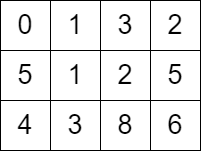
**Input:** grid = [[0,1,3,2],[5,1,2,5],[4,3,8,6]]
**Output:** 7
**Explanation:** One of the paths that we can take is the following:
- at t = 0, we are on the cell (0,0).
- at t = 1, we move to the cell (0,1). It is possible because grid[0][1] <= 1.
- at t = 2, we move to the cell (1,1). It is possible because grid[1][1] <= 2.
- at t = 3, we move to the cell (1,2). It is possible because grid[1][2] <= 3.
- at t = 4, we move to the cell (1,1). It is possible because grid[1][1] <= 4.
- at t = 5, we move to the cell (1,2). It is possible because grid[1][2] <= 5.
- at t = 6, we move to the cell (1,3). It is possible because grid[1][3] <= 6.
- at t = 7, we move to the cell (2,3). It is possible because grid[2][3] <= 7.
The final time is 7. It can be shown that it is the minimum time possible.
Example 2:
1
2
3
4
5

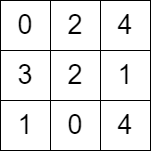
**Input:** grid = [[0,2,4],[3,2,1],[1,0,4]]
**Output:** -1
**Explanation:** There is no path from the top left to the bottom-right cell.
Constraints:
1
2
3
4
5
6
m == grid.length
n == grid[i].length
2 <= m, n <= 1000
4 <= m * n <= 105
0 <= grid[i][j] <= 105
grid[0][0] == 0
1
2
3
4
5
6
7
8
9
10
11
12
13
14
15
16
17
18
19
20
21
22
23
24
25
26
27
28
29
30
31
32
33
34
35
36
37
38
39
40
41
42
43
44
45
46
47
48
49
50
51


class Solution:
    def minimumTime(self, grid: List[List[int]]) -> int:
        # If both initial moves require more than 1 second, impossible to proceed
        if grid[0][1] > 1 and grid[1][0] > 1:
            return -1

        rows, cols = len(grid), len(grid[0])
        # Possible movements: down, up, right, left
        directions = [(1, 0), (-1, 0), (0, 1), (0, -1)]
        visited = set()

        # Priority queue stores (time, row, col)
        # Ordered by minimum time to reach each cell
        pq = [(grid[0][0], 0, 0)]

        while pq:
            time, row, col = heapq.heappop(pq)

            # Check if reached target
            if (row, col) == (rows - 1, cols - 1):
                return time

            # Skip if cell already visited
            if (row, col) in visited:
                continue
            visited.add((row, col))

            # Try all four directions
            for dx, dy in directions:
                next_row, next_col = row + dx, col + dy

                if not self._is_valid(visited, next_row, next_col, rows, cols):
                    continue

                # Calculate the wait time needed to move to next cell
                wait_time = (
                    1 if (grid[next_row][next_col] - time) % 2 == 0 else 0
                )
                next_time = max(grid[next_row][next_col] + wait_time, time + 1)
                heapq.heappush(pq, (next_time, next_row, next_col))

        return -1

    # Checks if given cell coordinates are valid and unvisited
    def _is_valid(self, visited, row, col, rows, cols):
        return 0 <= row < rows and 0 <= col < cols and (row, col) not in visited
This post is licensed under CC BY 4.0 by the author.