1485 Minimum Cost To Make At Least One Valid Path In A Grid
1485 Minimum Cost To Make At Least One Valid Path In A Grid
Minimum Cost to Make at Least One Valid Path in a Grid 
Given an m x n grid. Each cell of the grid has a sign pointing to the next cell you should visit if you are currently in this cell. The sign of grid[i][j] can be:
1
2
3
4
1 which means go to the cell to the right. (i.e go from grid[i][j] to grid[i][j + 1])
2 which means go to the cell to the left. (i.e go from grid[i][j] to grid[i][j - 1])
3 which means go to the lower cell. (i.e go from grid[i][j] to grid[i + 1][j])
4 which means go to the upper cell. (i.e go from grid[i][j] to grid[i - 1][j])
Notice that there could be some signs on the cells of the grid that point outside the grid.
You will initially start at the upper left cell (0, 0). A valid path in the grid is a path that starts from the upper left cell (0, 0) and ends at the bottom-right cell (m - 1, n - 1) following the signs on the grid. The valid path does not have to be the shortest.
You can modify the sign on a cell with cost = 1. You can modify the sign on a cell one time only.
Return the minimum cost to make the grid have at least one valid path.
Example 1:
1
2
3
4
5
6
7

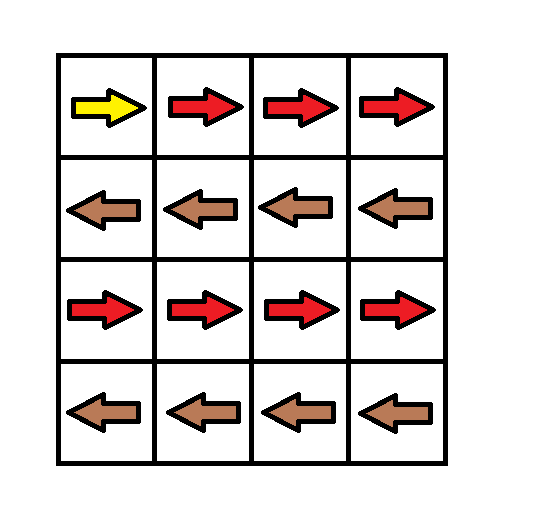
**Input:** grid = [[1,1,1,1],[2,2,2,2],[1,1,1,1],[2,2,2,2]]
**Output:** 3
**Explanation:** You will start at point (0, 0).
The path to (3, 3) is as follows. (0, 0) --> (0, 1) --> (0, 2) --> (0, 3) change the arrow to down with cost = 1 --> (1, 3) --> (1, 2) --> (1, 1) --> (1, 0) change the arrow to down with cost = 1 --> (2, 0) --> (2, 1) --> (2, 2) --> (2, 3) change the arrow to down with cost = 1 --> (3, 3)
The total cost = 3.
Example 2:
1
2
3
4
5

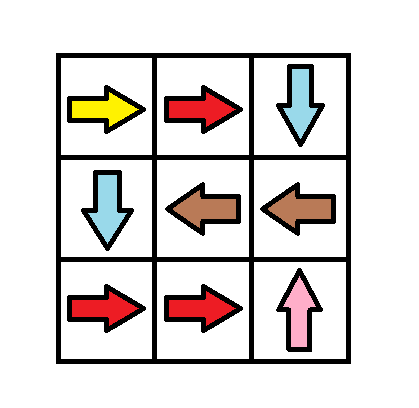
**Input:** grid = [[1,1,3],[3,2,2],[1,1,4]]
**Output:** 0
**Explanation:** You can follow the path from (0, 0) to (2, 2).
Example 3:
1
2
3
4

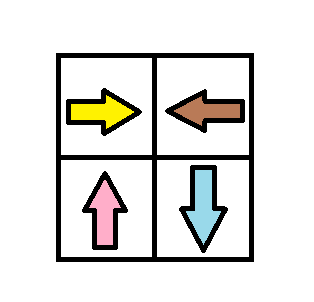
**Input:** grid = [[1,2],[4,3]]
**Output:** 1
Constraints:
1
2
3
4
m == grid.length
n == grid[i].length
1 <= m, n <= 100
1 <= grid[i][j] <= 4
1
2
3
4
5
6
7
8
9
10
11
12
13
14
15
16
17
18
19
20
21
22
23
24
25
26
27
28
29
30
31
32
33
34
35
36
37
38
39
40
41
42
43
44
45
46
47
48
49
50
51
52
53
54
55
56
57


class Solution:
    def minCost(self, grid: List[List[int]]) -> int:
        num_rows, num_cols = len(grid), len(grid[0])

        # Initialize all cells with max value
        min_changes = [[float("inf")] * num_cols for _ in range(num_rows)]
        min_changes[0][0] = 0

        while True:
            # Store previous state to check for convergence
            prev_state = [row[:] for row in min_changes]

            # Forward pass: check cells coming from left and top
            for row in range(num_rows):
                for col in range(num_cols):
                    # Check cell above
                    if row > 0:
                        min_changes[row][col] = min(
                            min_changes[row][col],
                            min_changes[row - 1][col]
                            + (0 if grid[row - 1][col] == 3 else 1),
                        )
                    # Check cell to the left
                    if col > 0:
                        min_changes[row][col] = min(
                            min_changes[row][col],
                            min_changes[row][col - 1]
                            + (0 if grid[row][col - 1] == 1 else 1),
                        )

            # Backward pass: check cells coming from right and bottom
            for row in range(num_rows - 1, -1, -1):
                for col in range(num_cols - 1, -1, -1):
                    # Check cell below
                    if row < num_rows - 1:
                        min_changes[row][col] = min(
                            min_changes[row][col],
                            min_changes[row + 1][col]
                            + (0 if grid[row + 1][col] == 4 else 1),
                        )
                    # Check cell to the right
                    if col < num_cols - 1:
                        min_changes[row][col] = min(
                            min_changes[row][col],
                            min_changes[row][col + 1]
                            + (0 if grid[row][col + 1] == 2 else 1),
                        )
            # If no changes were made in this iteration, we've found optimal solution
            if min_changes == prev_state:
                break

        return min_changes[num_rows - 1][num_cols - 1]
This post is licensed under CC BY 4.0 by the author.