896 Smallest Subtree With All The Deepest Nodes
896 Smallest Subtree With All The Deepest Nodes
Smallest Subtree with all the Deepest Nodes 
Given the root of a binary tree, the depth of each node is the shortest distance to the root.
Return the smallest subtree such that it contains all the deepest nodes in the original tree.
A node is called the deepest if it has the largest depth possible among any node in the entire tree.
The subtree of a node is a tree consisting of that node, plus the set of all descendants of that node.
Example 1:
1
2
3
4
5
6
7

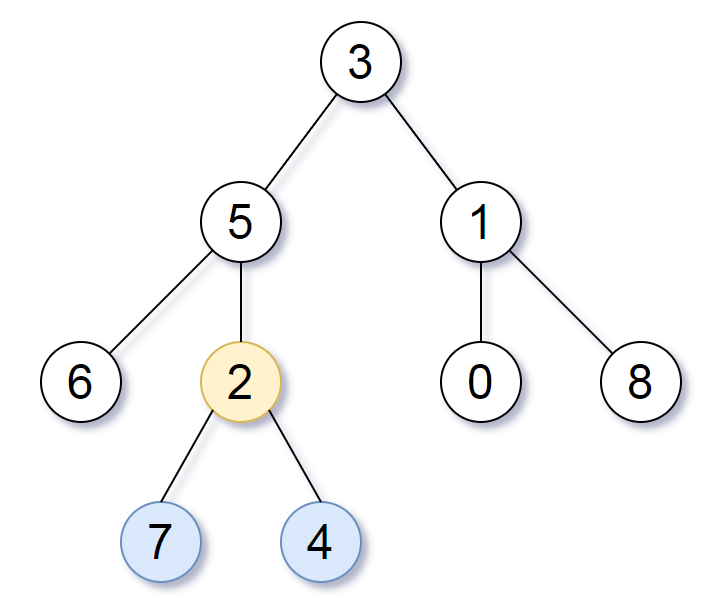
**Input:** root = [3,5,1,6,2,0,8,null,null,7,4]
**Output:** [2,7,4]
**Explanation:** We return the node with value 2, colored in yellow in the diagram.
The nodes coloured in blue are the deepest nodes of the tree.
Notice that nodes 5, 3 and 2 contain the deepest nodes in the tree but node 2 is the smallest subtree among them, so we return it.
Example 2:
1
2
3
4
5

**Input:** root = [1]
**Output:** [1]
**Explanation:** The root is the deepest node in the tree.
Example 3:
1
2
3
4
5

**Input:** root = [0,1,3,null,2]
**Output:** [2]
**Explanation:** The deepest node in the tree is 2, the valid subtrees are the subtrees of nodes 2, 1 and 0 but the subtree of node 2 is the smallest.
Constraints:
1
2
3
The number of nodes in the tree will be in the range [1, 500].
0 <= Node.val <= 500
The values of the nodes in the tree are **unique**.
Note: This question is the same as 1123: https://leetcode.com/problems/lowest-common-ancestor-of-deepest-leaves/
1
2
3
4
5
6
7
8
9
10
11
12
13
14
15
16
17
18
19
20
21
22
23
24
25
26
27
28
29
30
31
32
33
34
35
36
37
38
39
40
41
42
43
44
45
46
47
48
49
50
51
52
53
54
55
56
57
58
59
60
61
62
63
64
65
66
67
68
69


# Definition for a binary tree node.
# class TreeNode:
#     def __init__(self, val=0, left=None, right=None):
#         self.val = val
#         self.left = left
#         self.right = right
class Solution:
    def subtreeWithAllDeepest(self, root: Optional[TreeNode]) -> Optional[TreeNode]:
        # lvl ord trav
        # mainntain each levl in array
        # latest lvl with count 1
        r = []
        arr = [root]

        def recurse(arr, r):
            if len(arr) == 0:
                return
            temp = []
            r.append(copy.deepcopy(arr))
            while(arr):
                n = arr.pop()

                if n.left:
                    temp.append(n.left)

                if n.right:
                    temp.append(n.right)

            recurse(temp, r)
        recurse(arr, r)
        #print(r[-1])
        r = r[-1]
        # r has leaf nodes
        ans = {"ans": None}
        def is_valid(root, r, count):
            if root == None:
                return
            #print(root, count)
            if root.val in map(lambda x: x.val, r):
                count["c"] += 1
                return
            is_valid(root.left, r, count)
            is_valid(root.right, r, count)


        def dfs(root, r):
            if not root:
                return
            count = {"c": 0}
            is_valid(root, r , count)
            #print(count, r)
            if count["c"] == len(r):

                ans["ans"] = root
            dfs(root.left, r)
            dfs(root.right, r) # only one of these will be correct ,
            # if both are true that means parent is the ans

        dfs(root, r)
        return ans["ans"]
This post is licensed under CC BY 4.0 by the author.