870 Magic Squares In Grid
870 Magic Squares In Grid
Magic Squares In Grid 
A 3 x 3 magic square is a 3 x 3 grid filled with distinct numbers from **1 to **9 such that each row, column, and both diagonals all have the same sum.
Given a row x col grid of integers, how many 3 x 3 magic square subgrids are there?
Note: while a magic square can only contain numbers from 1 to 9, grid may contain numbers up to 15.
Example 1:
1
2
3
4
5
6
7
8
9
10
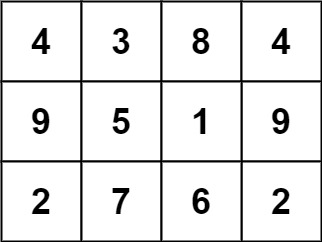
**Input:** grid = [[4,3,8,4],[9,5,1,9],[2,7,6,2]]
**Output:** 1
**Explanation: **
The following subgrid is a 3 x 3 magic square:
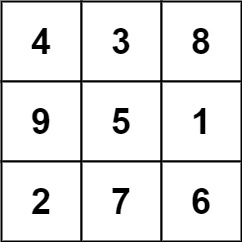
while this one is not:
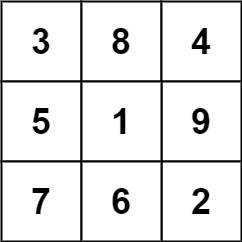
In total, there is only one magic square inside the given grid.
Example 2:
1
2
3
4

**Input:** grid = [[8]]
**Output:** 0
Constraints:
1
2
3
4
row == grid.length
col == grid[i].length
1 <= row, col <= 10
0 <= grid[i][j] <= 15
1
2
3
4
5
6
7
8
9
10
11
12
13
14
15
16
17
18
19
20
21
22
23
24
25
26
27
28
29
30
31
32
33
34
35
36
37
38
39
40
41
42
43
44
45
46
47
48
49
50
51
52
53
54
55
56
57
58
59
60
61
62
63
64
65
66
67
68
69
70
71
72
73
74
75
76
77
78
79
80
81
82
83
84
85
86
87
88
89
90
91
92
93
94
95
96
97
98
99
100
101
102
103
104
105
106
107
108


use std::collections::HashSet;
impl Solution {
    pub fn num_magic_squares_inside(grid: Vec<Vec<i32>>) -> i32 {


        fn is_magic_square(g: Vec<Vec<i32>>) -> bool {
            //print!("{:?}", g);
            let mut a = 0;
            for k in g.clone() {
                let mut s = 0;
                for m in k {
                    s += m
                }
                if a == 0 {
                    a = s
                } else {
                    if (a != s) {
                        return false
                    }
                }
            }

            if a != g[0][0] + g[1][1] + g[2][2] {
                return false;
            }

            if a != g[0][2] + g[1][1] + g[2][0] {
                return false;
            }

            if a != g[0][0] + g[1][0] + g[2][0] {
                return false;
            }

            if a != g[0][1] + g[1][1] + g[2][1] {
                return false;
            }

            if a != g[0][2] + g[1][2] + g[2][2] {
                return false;
            }

            let mut hs = HashSet::new();
            hs.insert(g[0][0]);
            hs.insert(g[0][1]);
            hs.insert(g[0][2]);
            hs.insert(g[1][0]);
            hs.insert(g[1][1]);
            hs.insert(g[1][2]);
            hs.insert(g[2][0]);
            hs.insert(g[2][1]);
            hs.insert(g[2][2]);
            if hs.len() != 9 {
                return false;
            }
            if hs.contains(&0) {
                return false;
            }
            if g[0][0] + g[0][1] + g[0][2] + g[1][0] + g[1][1] + g[1][2] + g[2][0] + g[2][1] + g[2][2]  != 45 {
                return false;
            }
            return true;
        }


        let mut i  = 0;
        let mut j = 0;
        let mut ans = 0;
        for i in 0..grid.len() {

            let mut d = i;
            for j in 0..grid[i].len() {
                let mut m = Vec::new();

                while(d < i + 3) {
                    let mut n = Vec::new();
                    if j + 2 < grid[i].len() && d < grid.len() {
                    n.push(grid[d][j]);
                    n.push(grid[d][j+1]);
                    n.push(grid[d][j+2]);
                    } else {
                        break
                    }
                    d += 1;
                    m.push(n.clone());
                    //print!("{:?} nnnnn", m);
                }

                if m.len() == 3 && is_magic_square(m.clone()) {
                    ans += 1;
                }


                d = i;

            }
        }

        return ans;

    }
}
This post is licensed under CC BY 4.0 by the author.