3819 Count Covered Buildings
3819 Count Covered Buildings
Count Covered Buildings 
You are given a positive integer n, representing an n x n city. You are also given a 2D grid buildings, where buildings[i] = [x, y] denotes a unique building located at coordinates [x, y].
A building is covered if there is at least one building in all four directions: left, right, above, and below.
Return the number of covered buildings.
Example 1:
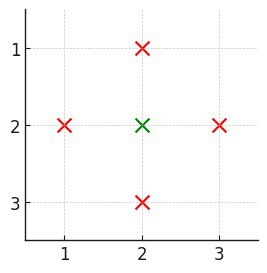
Input: n = 3, buildings = [[1,2],[2,2],[3,2],[2,1],[2,3]]
Output: 1
Explanation:
1
2
3
4
5
6
7
8
Only building [2,2] is covered as it has at least one building:

	above ([1,2])
	below ([3,2])
	left ([2,1])
	right ([2,3])

Thus, the count of covered buildings is 1.
Example 2:
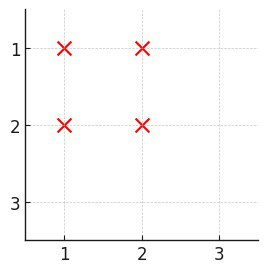
Input: n = 3, buildings = [[1,1],[1,2],[2,1],[2,2]]
Output: 0
Explanation:
1
No building has at least one building in all four directions.
Example 3:

Input: n = 5, buildings = [[1,3],[3,2],[3,3],[3,5],[5,3]]
Output: 1
Explanation:
1
2
3
4
5
6
7
8
Only building [3,3] is covered as it has at least one building:

	above ([1,3])
	below ([5,3])
	left ([3,2])
	right ([3,5])

Thus, the count of covered buildings is 1.
Constraints:
1
2
3
4
5
2 <= n <= 105
1 <= buildings.length <= 105
buildings[i] = [x, y]
1 <= x, y <= n
All coordinates of buildings are **unique**.
1
2
3
4
5
6
7
8
9
10
11
12
13
14
15
16
17
18
19
20
21
22
23
24
25
26
27
28
29
30
31
32
33
34
35
36
37


impl Solution {
    pub fn count_covered_buildings(n: i32, buildings: Vec<Vec<i32>>) -> i32 {
        let n_usize = n as usize;
        let mut max_row = vec![0; n_usize + 1];
        let mut min_row = vec![n + 1; n_usize + 1];
        let mut max_col = vec![0; n_usize + 1];
        let mut min_col = vec![n + 1; n_usize + 1];

        for p in &buildings {
            let x = p[0] as usize;
            let y = p[1] as usize;

            max_row[y] = max_row[y].max(x as i32);
            min_row[y] = min_row[y].min(x as i32);
            max_col[x] = max_col[x].max(y as i32);
            min_col[x] = min_col[x].min(y as i32);
        }

        let mut res = 0;
        for p in &buildings {
            let x = p[0] as usize;
            let y = p[1] as usize;

            if (x as i32) > min_row[y] && (x as i32) < max_row[y] &&
               (y as i32) > min_col[x] && (y as i32) < max_col[x] {
                res += 1;
            }
        }

        res
    }
}
This post is licensed under CC BY 4.0 by the author.