3748 Sort Matrix By Diagonals
3748 Sort Matrix By Diagonals
Sort Matrix by Diagonals 
You are given an n x n square matrix of integers grid. Return the matrix such that:
1
2
The diagonals in the **bottom-left triangle** (including the middle diagonal) are sorted in **non-increasing order**.
The diagonals in the **top-right triangle** are sorted in **non-decreasing order**.
Example 1:
Input: grid = [[1,7,3],[9,8,2],[4,5,6]]
Output: [[8,2,3],[9,6,7],[4,5,1]]
Explanation:
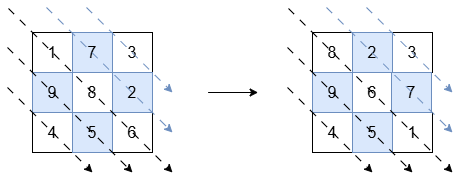
The diagonals with a black arrow (bottom-left triangle) should be sorted in non-increasing order:
1
2
[1, 8, 6] becomes [8, 6, 1].
[9, 5] and [4] remain unchanged.
The diagonals with a blue arrow (top-right triangle) should be sorted in non-decreasing order:
1
2
[7, 2] becomes [2, 7].
[3] remains unchanged.
Example 2:
Input: grid = [[0,1],[1,2]]
Output: [[2,1],[1,0]]
Explanation:
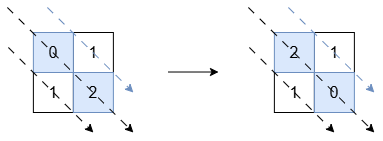
The diagonals with a black arrow must be non-increasing, so [0, 2] is changed to [2, 0]. The other diagonals are already in the correct order.
Example 3:
Input: grid = [[1]]
Output: [[1]]
Explanation:
Diagonals with exactly one element are already in order, so no changes are needed.
Constraints:
1
2
3
grid.length == grid[i].length == n
1 <= n <= 10
-105 <= grid[i][j] <= 105
1
2
3
4
5
6
7
8
9
10
11
12
13
14
15
16
17
18
19
20
21
22
23
24
25
26
27
28
29
30
31
32
33
34
35
36
37
38
39
40
41
42
43
44
45
46
47
48
49
50
51
52
53
54
55
56
57
58
59
60


class Solution:
    def sortMatrix(self, grid: List[List[int]]) -> List[List[int]]:
        """
            diagonals have
            0,2
            0,1 1,2
            0,0 1,1 2,2
            1,0 2,1
            2,0

            start with each cell in first row and keep adding 1,1 till we hit the boundary
        """
        n = len(grid)
        for k in range(n):
            arr = []
            i = 0
            j = k

            while(i < n and j < n):
                arr.append(grid[i][j])
                i += 1
                j += 1
            arr.sort(key=lambda x : x)
            print(arr)
            i = 0
            j = k
            l = 0
            while(i < n and j < n):
                grid[i][j] = arr[l]
                l += 1
                i += 1
                j += 1

        for k in range(n):
            arr = []
            i = k
            j = 0

            while(i < n and j < n):
                arr.append(grid[i][j])
                i += 1
                j += 1
            arr.sort(key=lambda x : -x)
            print(arr)
            i = k
            j = 0
            l = 0
            while(i < n and j < n):
                grid[i][j] = arr[l]
                l += 1
                i += 1
                j += 1
        return grid
This post is licensed under CC BY 4.0 by the author.