3743 Reschedule Meetings For Maximum Free Time I
Reschedule Meetings for Maximum Free Time I 
You are given an integer eventTime denoting the duration of an event, where the event occurs from time t = 0 to time t = eventTime.
You are also given two integer arrays startTime and endTime, each of length n. These represent the start and end time of n non-overlapping meetings, where the ith meeting occurs during the time [startTime[i], endTime[i]].
You can reschedule at most k meetings by moving their start time while maintaining the same duration, to maximize the longest continuous period of free time during the event.
The relative order of all the meetings should stay the* same* and they should remain non-overlapping.
Return the maximum amount of free time possible after rearranging the meetings.
Note that the meetings can not be rescheduled to a time outside the event.
Example 1:
Input: eventTime = 5, k = 1, startTime = [1,3], endTime = [2,5]
Output: 2
Explanation:
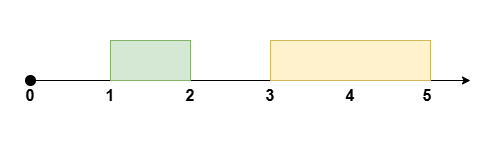
Reschedule the meeting at [1, 2] to [2, 3], leaving no meetings during the time [0, 2].
Example 2:
Input: eventTime = 10, k = 1, startTime = [0,2,9], endTime = [1,4,10]
Output: 6
Explanation:
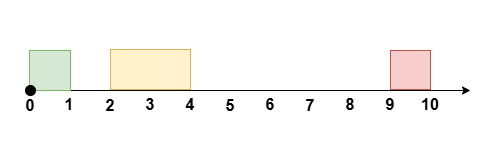
Reschedule the meeting at [2, 4] to [1, 3], leaving no meetings during the time [3, 9].
Example 3:
Input: eventTime = 5, k = 2, startTime = [0,1,2,3,4], endTime = [1,2,3,4,5]
Output: 0
Explanation:
There is no time during the event not occupied by meetings.
Constraints:
1
2
3
4
5
6
1 <= eventTime <= 109
n == startTime.length == endTime.length
2 <= n <= 105
1 <= k <= n
0 <= startTime[i] < endTime[i] <= eventTime
endTime[i] <= startTime[i + 1] where i lies in the range [0, n - 2].
1
2
3
4
5
6
7
8
9
10
11
12
13
14
15
16
17
18
19
20
21
22
23
24
25
26
27
28
29
30
31
32
33
34
35
36
37
38
39
40
41
42
43
44
45
46
47
48
49
50
51
52
53
54
55
56
57
58
59


class Solution:
    def maxFreeTime(self, eventTime: int, k: int, startTime: List[int], endTime: List[int]) -> int:
        """
        the longest free time can be achived if they are all togather
        also to maintain the order, find the smallest empty gaps and reduce it further -> no this may not work
        then find largest empty gaps and increase it
        y greedy works - say increasing largest by x  does not yield the largest time, then it means inc 2nd largest by x yields ? which cannot be true as if x > y, then x + 3 > y + 3
            maybe we take all free spaces and then start moving empty spaces to larger one k times
            start by reducing largest meeting
        # this greedy did not work as it was possible to move left or right side as well, rather take k window and
        find me maximum output
        """
        duration = []
        start_time = 0
        end_time = 0
        for i, (start, end) in enumerate(zip(startTime, endTime)):
            duration.append((i,start-end_time))
            start_time = start
            end_time = end
        duration.append((i+1, eventTime - endTime[-1]))

        total = 0
        left = 0
        right = 0
        print(duration)
        while(right - left < k + 1) and right < len(duration):
                total += duration[right][1]
                right += 1
        max_total = total

        # Slide the window
        while right < len(duration):
            total -= duration[left][1]
            total += duration[right][1]
            left += 1
            right += 1
            max_total = max(max_total, total)

        return max_total


        return duration[0] + total   if len(duration) > 0 else 0