3657 Check If Grid Can Be Cut Into Sections
Check if Grid can be Cut into Sections 
You are given an integer n representing the dimensions of an n x n grid, with the origin at the bottom-left corner of the grid. You are also given a 2D array of coordinates rectangles, where rectangles[i] is in the form [startx, starty, endx, endy], representing a rectangle on the grid. Each rectangle is defined as follows:
1
2
(startx, starty): The bottom-left corner of the rectangle.
(endx, endy): The top-right corner of the rectangle.
Note **that the rectangles do not overlap. Your task is to determine if it is possible to make **either two horizontal or two vertical cuts on the grid such that:
1
2
Each of the three resulting sections formed by the cuts contains **at least** one rectangle.
Every rectangle belongs to **exactly** one section.
Return true if such cuts can be made; otherwise, return false.
Example 1:
Input: n = 5, rectangles = [[1,0,5,2],[0,2,2,4],[3,2,5,3],[0,4,4,5]]
Output: true
Explanation:
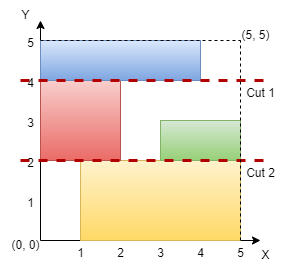
The grid is shown in the diagram. We can make horizontal cuts at y = 2 and y = 4. Hence, output is true.
Example 2:
Input: n = 4, rectangles = [[0,0,1,1],[2,0,3,4],[0,2,2,3],[3,0,4,3]]
Output: true
Explanation:
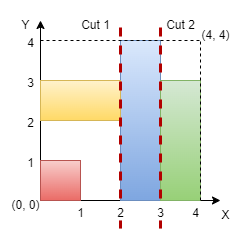
We can make vertical cuts at x = 2 and x = 3. Hence, output is true.
Example 3:
Input: n = 4, rectangles = [[0,2,2,4],[1,0,3,2],[2,2,3,4],[3,0,4,2],[3,2,4,4]]
Output: false
Explanation:
We cannot make two horizontal or two vertical cuts that satisfy the conditions. Hence, output is false.
Constraints:
1
2
3
4
5
3 <= n <= 109
3 <= rectangles.length <= 105
0 <= rectangles[i][0] < rectangles[i][2] <= n
0 <= rectangles[i][1] < rectangles[i][3] <= n
No two rectangles overlap.
1
2
3
4
5
6
7
8
9
10
11
12
13
14
15
16
17
18
19
20
21
22
23
24
25
26
27
28
29
30
31
32
33
34
35
36
37
38
39
40
41
42
43
44
45
46
47


class Solution:
    def checkValidCuts(self, n: int, rectangles: List[List[int]]) -> bool:
        # find at least 3 non overlapping rectangles
        # [0,2] , [2,4], [2,3], [4,5]
        # merge intervals and find at least 3 , nore than 3 also ok ? looks yes

        x_rect = []
        y_rect = []

        for k in rectangles:
            x_rect.append([k[1],k[3]])
            y_rect.append([k[0],k[2]])

        def merge_intervals(arr):

            arr.sort(key= lambda x: x[0])
            #print(arr)

            start = -1
            end = -1
            count = 0

            for k in arr:
                if end <= k[0]:
                    count += 1
                    start = k[0]
                    end = k[1]
                else:
                    end = max(k[1], end)

            #print(count)
            return count >= 3
        return merge_intervals(x_rect) or merge_intervals(y_rect)