3278 Find The Number Of Ways To Place People I
3278 Find The Number Of Ways To Place People I
Find the Number of Ways to Place People I 
You are given a 2D array points of size n x 2 representing integer coordinates of some points on a 2D plane, where points[i] = [xi, yi].
Count the number of pairs of points (A, B), where
1
2
A is on the **upper left** side of B, and
there are no other points in the rectangle (or line) they make (**including the border**).
Return the count.
Example 1:
Input: points = [[1,1],[2,2],[3,3]]
Output: 0
Explanation:
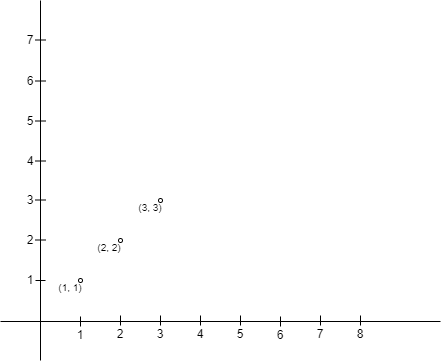
There is no way to choose A and B so A is on the upper left side of B.
Example 2:
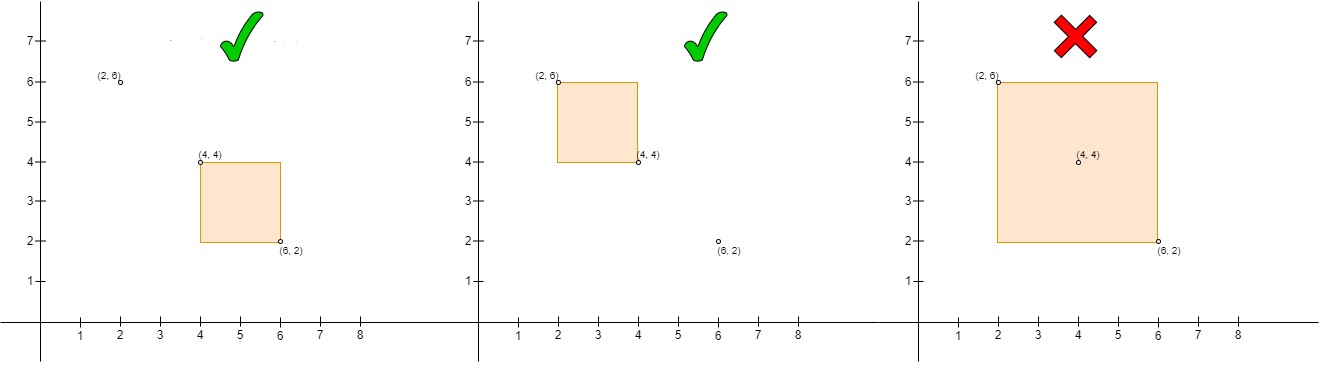
Input: points = [[6,2],[4,4],[2,6]]
Output: 2
Explanation:
1
2
3
The left one is the pair (points[1], points[0]), where points[1] is on the upper left side of points[0] and the rectangle is empty.
The middle one is the pair (points[2], points[1]), same as the left one it is a valid pair.
The right one is the pair (points[2], points[0]), where points[2] is on the upper left side of points[0], but points[1] is inside the rectangle so it's not a valid pair.
Example 3:
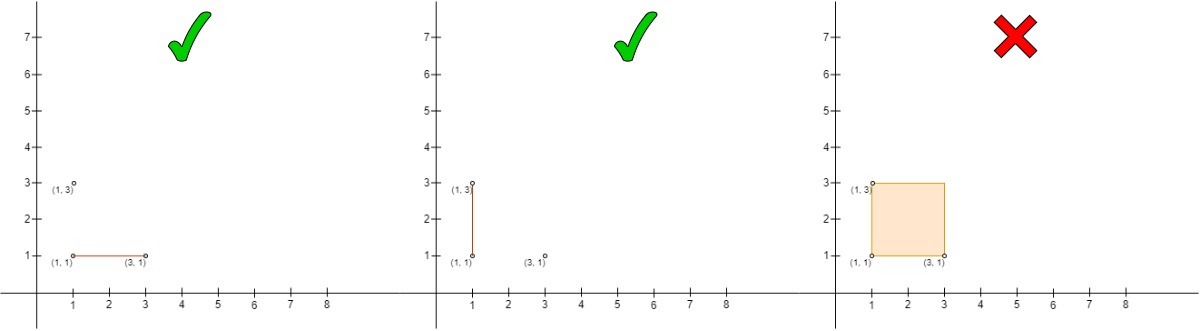
Input: points = [[3,1],[1,3],[1,1]]
Output: 2
Explanation:
1
2
3
The left one is the pair (points[2], points[0]), where points[2] is on the upper left side of points[0] and there are no other points on the line they form. Note that it is a valid state when the two points form a line.
The middle one is the pair (points[1], points[2]), it is a valid pair same as the left one.
The right one is the pair (points[1], points[0]), it is not a valid pair as points[2] is on the border of the rectangle.
Constraints:
1
2
3
4
2 <= n <= 50
points[i].length == 2
0 <= points[i][0], points[i][1] <= 50
All points[i] are distinct.
1
2
3
4
5
6
7
8
9
10
11
12
13
14
15
16
17
18
19
20
21
22
23
24
25
26
27
28
29
30
31
32
33
34
35
36
37
38
39
40
41
42
43
44
45
46
47
48
49
50
51
52
53
54


use std::collections::HashSet;

impl Solution {
    pub fn number_of_pairs(points: Vec<Vec<i32>>) -> i32 {
        // upper left is x <= mx and y >= my
        // to form a rect - mx and nx and my and ny , no points should lie here
        // n is 50, so we could just nest two loops
        // to find if a point lies in rect, we need to keep sorted arr of both x and y and find common between both arrays
        // that's third loop -> we could also perform bin search here
        //
        let mut x_sorted = points.clone();
        x_sorted.sort_by(|a, b| a[0].cmp(&b[0]));
        let mut y_sorted = points.clone();
        y_sorted.sort_by(|a, b| a[1].cmp(&b[1]));
        let mut res = 0;
        for k in &points {
            for l in &points {
                if k == l {
                    continue
                }
                let ax = k[0];
                let ay = k[1];
                let bx = l[0];
                let by = l[1];

                if ax > bx || ay < by {
                    continue;
                }

                let mut valid = true;
                for m in &points {
                    if m == k || m == l {
                        continue;
                    }
                    if ax <= m[0] && m[0] <= bx && by <= m[1] && m[1] <= ay {
                        valid = false; // point lies inside or on boundary
                        break;
                    }
                }

                if valid {
                    res += 1;
                }

            }
        }
        res
    }
}
This post is licensed under CC BY 4.0 by the author.