3058 Maximum Number Of K Divisible Components
3058 Maximum Number Of K Divisible Components
Maximum Number of K-Divisible Components 
There is an undirected tree with n nodes labeled from 0 to n - 1. You are given the integer n and a 2D integer array edges of length n - 1, where edges[i] = [ai, bi] indicates that there is an edge between nodes ai and bi in the tree.
You are also given a 0-indexed integer array values of length n, where values[i] is the value associated with the ith node, and an integer k.
A valid split of the tree is obtained by removing any set of edges, possibly empty, from the tree such that the resulting components all have values that are divisible by k, where the value of a connected component is the sum of the values of its nodes.
Return the maximum number of components in any valid split.
Example 1:
1
2
3
4
5
6
7

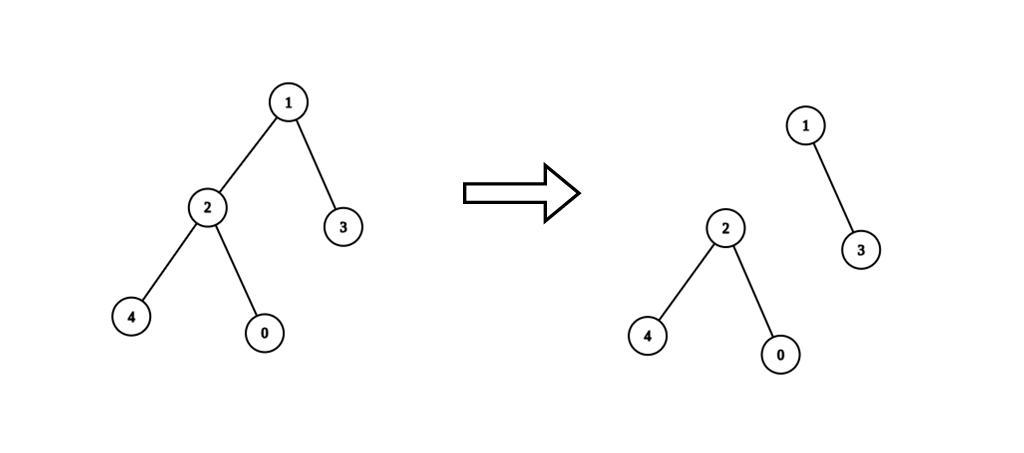
**Input:** n = 5, edges = [[0,2],[1,2],[1,3],[2,4]], values = [1,8,1,4,4], k = 6
**Output:** 2
**Explanation:** We remove the edge connecting node 1 with 2. The resulting split is valid because:
- The value of the component containing nodes 1 and 3 is values[1] + values[3] = 12.
- The value of the component containing nodes 0, 2, and 4 is values[0] + values[2] + values[4] = 6.
It can be shown that no other valid split has more than 2 connected components.
Example 2:
1
2
3
4
5
6
7
8
9

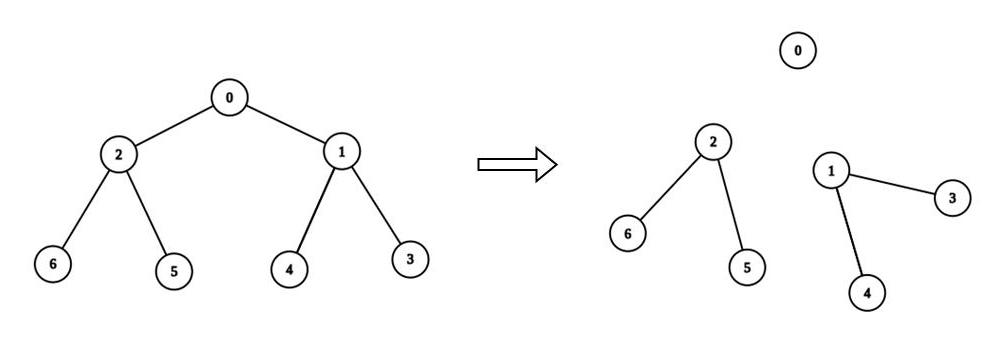
**Input:** n = 7, edges = [[0,1],[0,2],[1,3],[1,4],[2,5],[2,6]], values = [3,0,6,1,5,2,1], k = 3
**Output:** 3
**Explanation:** We remove the edge connecting node 0 with 2, and the edge connecting node 0 with 1. The resulting split is valid because:
- The value of the component containing node 0 is values[0] = 3.
- The value of the component containing nodes 2, 5, and 6 is values[2] + values[5] + values[6] = 9.
- The value of the component containing nodes 1, 3, and 4 is values[1] + values[3] + values[4] = 6.
It can be shown that no other valid split has more than 3 connected components.
Constraints:
1
2
3
4
5
6
7
8
9
1 <= n <= 3 * 104
edges.length == n - 1
edges[i].length == 2
0 <= ai, bi < n
values.length == n
0 <= values[i] <= 109
1 <= k <= 109
Sum of values is divisible by k.
The input is generated such that edges represents a valid tree.
1
2
3
4
5
6
7
8
9
10
11
12
13
14
15
16
17
18
19
20
21
22
23
24
25
26
27
28
29
30
31
32
33
34
35
36
37
38
39
40
41
42
43
44
45
46
47
48
49
50
51
52
53
54
55
56
57
58
59
60


class Solution:
    def maxKDivisibleComponents(
        self, n: int, edges: List[List[int]], values: List[int], k: int
    ) -> int:
        # Step 1: Create adjacency list from edges
        adj_list = [[] for _ in range(n)]
        for node1, node2 in edges:
            adj_list[node1].append(node2)
            adj_list[node2].append(node1)

        # Step 2: Initialize component count
        component_count = [0]  # Use a list to pass by reference

        # Step 3: Start DFS traversal from node 0
        self.dfs(0, -1, adj_list, values, k, component_count)

        # Step 4: Return the total number of components
        return component_count[0]

    def dfs(
        self,
        current_node: int,
        parent_node: int,
        adj_list: List[List[int]],
        node_values: List[int],
        k: int,
        component_count: List[int],
    ) -> int:
        # Step 1: Initialize sum for the current subtree
        sum_ = 0

        # Step 2: Traverse all neighbors
        for neighbor_node in adj_list[current_node]:
            if neighbor_node != parent_node:
                # Recursive call to process the subtree rooted at the neighbor
                sum_ += self.dfs(
                    neighbor_node,
                    current_node,
                    adj_list,
                    node_values,
                    k,
                    component_count,
                )
                sum_ %= k  # Ensure the sum stays within bounds

        # Step 3: Add the value of the current node to the sum
        sum_ += node_values[current_node]
        sum_ %= k

        # Step 4: Check if the sum is divisible by k
        if sum_ == 0:
            component_count[0] += 1

        # Step 5: Return the computed sum for the current subtree
        return sum_
This post is licensed under CC BY 4.0 by the author.