2794 Maximum Number Of Moves In A Grid
2794 Maximum Number Of Moves In A Grid
Maximum Number of Moves in a Grid 
You are given a 0-indexed m x n matrix grid consisting of positive integers.
You can start at any cell in the first column of the matrix, and traverse the grid in the following way:
1
From a cell (row, col), you can move to any of the cells: (row - 1, col + 1), (row, col + 1) and (row + 1, col + 1) such that the value of the cell you move to, should be **strictly** bigger than the value of the current cell.
Return the maximum number of moves that you can perform.
Example 1:
1
2
3
4
5
6
7
8

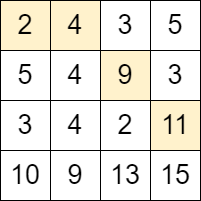
**Input:** grid = [[2,4,3,5],[5,4,9,3],[3,4,2,11],[10,9,13,15]]
**Output:** 3
**Explanation:** We can start at the cell (0, 0) and make the following moves:
- (0, 0) -> (0, 1).
- (0, 1) -> (1, 2).
- (1, 2) -> (2, 3).
It can be shown that it is the maximum number of moves that can be made.
Example 2:
1
2
3
4
5
6
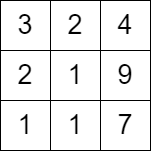
**Input:** grid = [[3,2,4],[2,1,9],[1,1,7]]
**Output:** 0
**Explanation:** Starting from any cell in the first column we cannot perform any moves.
Constraints:
1
2
3
4
5
m == grid.length
n == grid[i].length
2 <= m, n <= 1000
4 <= m * n <= 105
1 <= grid[i][j] <= 106
1
2
3
4
5
6
7
8
9
10
11
12
13
14
15
16
17
18
19
20
21
22
23
24
25
26
27
28
29
30
31


class Solution:
    def maxMoves(self, grid: List[List[int]]) -> int:

        row = len(grid)
        col = len(grid[0])

        @cache
        def maxmv(i, j):
            if i >= row or j >= col:
                return 0
            a,b,c = 0,0,0
            if i - 1 >= 0 and j + 1 < col and grid[i][j] < grid[i -1][j+1]:
                a = 1 + maxmv(i-1, j+1)

            if j + 1 < col and grid[i][j] < grid[i][j+1]:
                b = 1 + maxmv(i, j+1)

            if i+1 < row and j +1 < col and grid[i][j] < grid[i +1][j+1]:
                c = 1 + maxmv(i+1, j+1)


            return max(a,b,c)
        res = 0
        for k in range(row):
            res = max(res, maxmv(k,0))
        return res
This post is licensed under CC BY 4.0 by the author.