2558 Minimum Number Of Operations To Sort A Binary Tree By Level
2558 Minimum Number Of Operations To Sort A Binary Tree By Level
Minimum Number of Operations to Sort a Binary Tree by Level 
You are given the root of a binary tree with unique values.
In one operation, you can choose any two nodes at the same level and swap their values.
Return the minimum number of operations needed to make the values at each level sorted in a strictly increasing order.
The level of a node is the number of edges along the path between it and the root node.
Example 1:
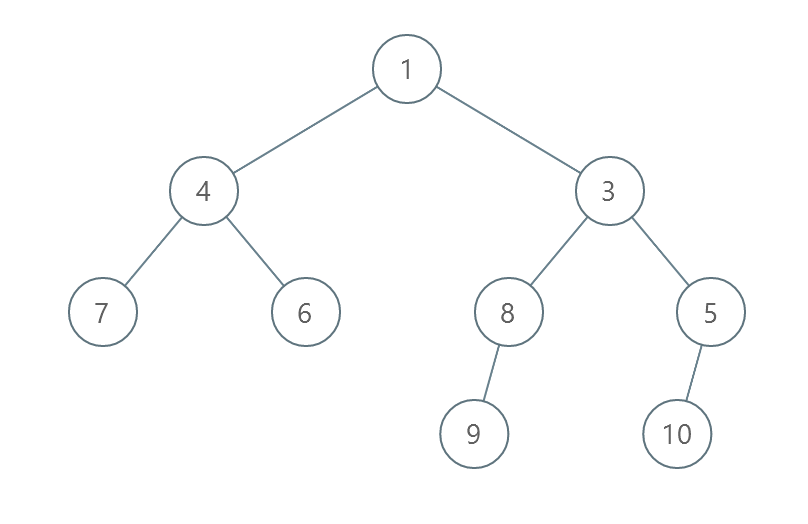
1
2
3
4
5
6
7
8
9
10

**Input:** root = [1,4,3,7,6,8,5,null,null,null,null,9,null,10]
**Output:** 3
**Explanation:**
- Swap 4 and 3. The 2nd level becomes [3,4].
- Swap 7 and 5. The 3rd level becomes [5,6,8,7].
- Swap 8 and 7. The 3rd level becomes [5,6,7,8].
We used 3 operations so return 3.
It can be proven that 3 is the minimum number of operations needed.
Example 2:
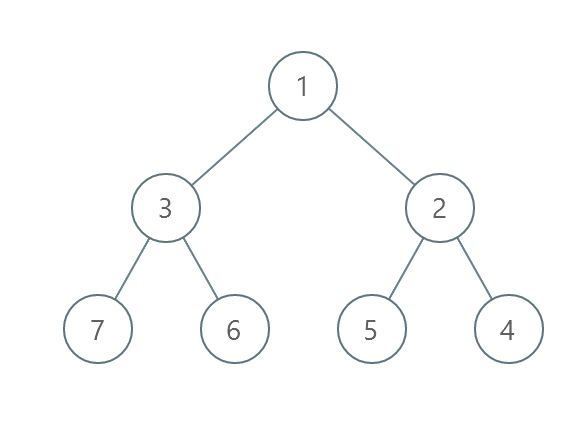
1
2
3
4
5
6
7
8
9
10

**Input:** root = [1,3,2,7,6,5,4]
**Output:** 3
**Explanation:**
- Swap 3 and 2. The 2nd level becomes [2,3].
- Swap 7 and 4. The 3rd level becomes [4,6,5,7].
- Swap 6 and 5. The 3rd level becomes [4,5,6,7].
We used 3 operations so return 3.
It can be proven that 3 is the minimum number of operations needed.
Example 3:
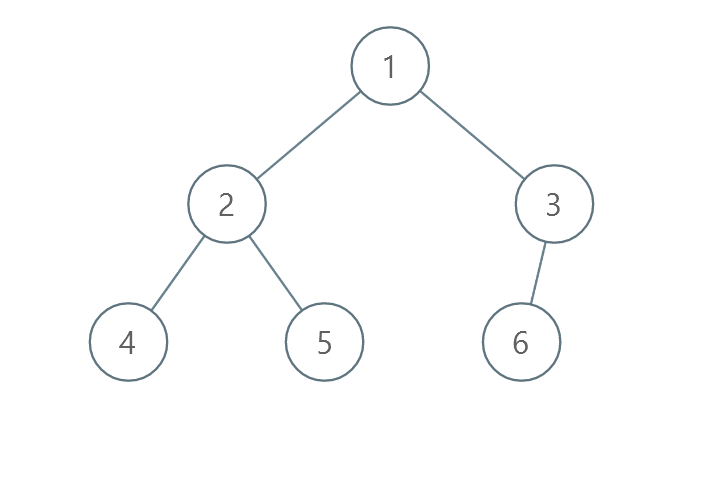
1
2
3
4
5

**Input:** root = [1,2,3,4,5,6]
**Output:** 0
**Explanation:** Each level is already sorted in increasing order so return 0.
Constraints:
1
2
3
The number of nodes in the tree is in the range [1, 105].
1 <= Node.val <= 105
All the values of the tree are **unique**.
1
2
3
4
5
6
7
8
9
10
11
12
13
14
15
16
17
18
19
20
21
22
23
24
25
26
27
28
29
30
31
32
33
34
35
36
37
38
39
40
41
42
43
44
45
46
47
48
49
50
51
52
53
54
55
56
57
58
59
60
61
62
63
64
65
66
67


# Definition for a binary tree node.
# class TreeNode:
#     def __init__(self, val=0, left=None, right=None):
#         self.val = val
#         self.left = left
#         self.right = right
class Solution:
    def minimumOperations(self, root: Optional[TreeNode]) -> int:
        """
        10,15,30,45
        15,45,30,10

        1-0,2-1,3,4,5,6,7-6
        1-0,7-1,5,3,6,4,2-6 1 + 1 + 1 + 1
        """

        def recurse(q):
            freq = {}


            sorted_q = sorted(list(map(lambda x: x.val , q)))

            # Create a mapping of node values to their original indices
            freq = {node.val: idx for idx, node in enumerate(q)}
            count = 0
            idx = 0
            idx = 0
            count = 0
            #print(sorted_q, freq)
            while(idx < len(q)):
                if sorted_q[idx] != q[idx].val:
                    a = sorted_q[idx]
                    b = q[idx].val
                    correct_index = freq[sorted_q[idx]]
                    q[idx].val, q[correct_index].val = q[correct_index].val, q[idx].val
                    freq[a], freq[b] = freq[b],freq[a]
                    count += 1
                    #print(list(map(lambda x:x.val, q)), sorted_q)
                idx += 1
            #print(freq, count)

            # 7,6,8,5 -> 5,6,7,8
            # 5 != 7
            # index of 5 in priginal arr
            # swap 5 and 7 in original arr
            # swap index of 5 and 7

            temp = []

            while(q):
                item = q.pop(0)

                if item.left:
                    temp.append(item.left)
                if item.right:
                    temp.append(item.right)
            return count + recurse(temp) if temp else count
        return recurse([root])
This post is licensed under CC BY 4.0 by the author.