2400 Minimum Score After Removals On A Tree
2400 Minimum Score After Removals On A Tree
Minimum Score After Removals on a Tree 
There is an undirected connected tree with n nodes labeled from 0 to n - 1 and n - 1 edges.
You are given a 0-indexed integer array nums of length n where nums[i] represents the value of the ith node. You are also given a 2D integer array edges of length n - 1 where edges[i] = [ai, bi] indicates that there is an edge between nodes ai and bi in the tree.
Remove two distinct edges of the tree to form three connected components. For a pair of removed edges, the following steps are defined:
1
2
3
4
Get the XOR of all the values of the nodes for **each** of the three components respectively.
The **difference** between the **largest** XOR value and the **smallest** XOR value is the **score** of the pair.

For example, say the three components have the node values: [4,5,7], [1,9], and [3,3,3]. The three XOR values are 4 ^ 5 ^ 7 = **6**, 1 ^ 9 = **8**, and 3 ^ 3 ^ 3 = **3**. The largest XOR value is 8 and the smallest XOR value is 3. The score is then 8 - 3 = 5.
Return the minimum score of any possible pair of edge removals on the given tree.
Example 1:
1
2
3
4
5
6
7
8
9
10

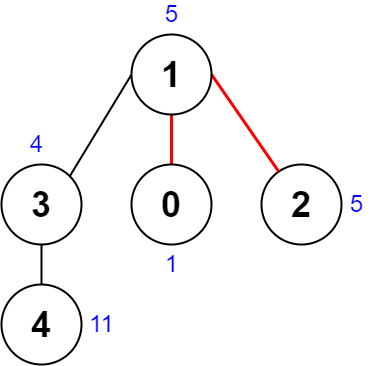
**Input:** nums = [1,5,5,4,11], edges = [[0,1],[1,2],[1,3],[3,4]]
**Output:** 9
**Explanation:** The diagram above shows a way to make a pair of removals.
- The 1st component has nodes [1,3,4] with values [5,4,11]. Its XOR value is 5 ^ 4 ^ 11 = 10.
- The 2nd component has node [0] with value [1]. Its XOR value is 1 = 1.
- The 3rd component has node [2] with value [5]. Its XOR value is 5 = 5.
The score is the difference between the largest and smallest XOR value which is 10 - 1 = 9.
It can be shown that no other pair of removals will obtain a smaller score than 9.
Example 2:
1
2
3
4
5
6
7
8
9
10

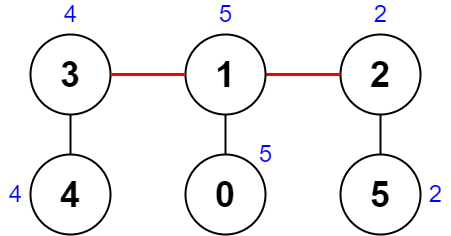
**Input:** nums = [5,5,2,4,4,2], edges = [[0,1],[1,2],[5,2],[4,3],[1,3]]
**Output:** 0
**Explanation:** The diagram above shows a way to make a pair of removals.
- The 1st component has nodes [3,4] with values [4,4]. Its XOR value is 4 ^ 4 = 0.
- The 2nd component has nodes [1,0] with values [5,5]. Its XOR value is 5 ^ 5 = 0.
- The 3rd component has nodes [2,5] with values [2,2]. Its XOR value is 2 ^ 2 = 0.
The score is the difference between the largest and smallest XOR value which is 0 - 0 = 0.
We cannot obtain a smaller score than 0.
Constraints:
1
2
3
4
5
6
7
8
n == nums.length
3 <= n <= 1000
1 <= nums[i] <= 108
edges.length == n - 1
edges[i].length == 2
0 <= ai, bi < n
ai != bi
edges represents a valid tree.
1
2
3
4
5
6
7
8
9
10
11
12
13
14
15
16
17
18
19
20
21
22
23
24
25
26
27
28
29
30
31
32
33
34
35
36
37
38
39
40
41
42
43
44
45
46
47


class Solution:
    def calc(self, part1: int, part2: int, part3: int) -> int:
        return max(part1, part2, part3) - min(part1, part2, part3)

    def minimumScore(self, nums: List[int], edges: List[List[int]]) -> int:
        n = len(nums)
        e = [[] for _ in range(n)]
        for u, v in edges:
            e[u].append(v)
            e[v].append(u)

        total = 0
        for x in nums:
            total ^= x

        res = float("inf")

        def dfs2(x: int, f: int, oth: int, anc: int) -> int:
            son = nums[x]
            for y in e[x]:
                if y == f:
                    continue
                son ^= dfs2(y, x, oth, anc)
            if f == anc:
                return son
            nonlocal res
            res = min(res, self.calc(oth, son, total ^ oth ^ son))
            return son

        def dfs(x: int, f: int) -> int:
            son = nums[x]
            for y in e[x]:
                if y == f:
                    continue
                son ^= dfs(y, x)
            for y in e[x]:
                if y == f:
                    dfs2(y, x, son, x)
            return son

        dfs(0, -1)
        return res
This post is licensed under CC BY 4.0 by the author.