2251 Number Of Ways To Divide A Long Corridor
Number of Ways to Divide a Long Corridor 
Along a long library corridor, there is a line of seats and decorative plants. You are given a 0-indexed string corridor of length n consisting of letters ‘S’ and ‘P’ where each ‘S’ represents a seat and each ‘P’ represents a plant.
One room divider has already been installed to the left of index 0, and another to the right of index n - 1. Additional room dividers can be installed. For each position between indices i - 1 and i (1 <= i <= n - 1), at most one divider can be installed.
Divide the corridor into non-overlapping sections, where each section has exactly two seats with any number of plants. There may be multiple ways to perform the division. Two ways are different if there is a position with a room divider installed in the first way but not in the second way.
Return the number of ways to divide the corridor. Since the answer may be very large, return it modulo 109 + 7. If there is no way, return 0.
Example 1:
1
2
3
4
5
6
7

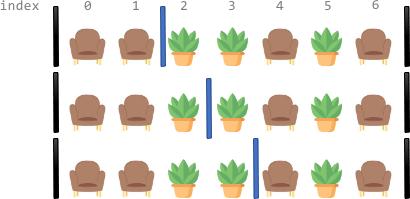
**Input:** corridor = "SSPPSPS"
**Output:** 3
**Explanation:** There are 3 different ways to divide the corridor.
The black bars in the above image indicate the two room dividers already installed.
Note that in each of the ways, **each** section has exactly **two** seats.
Example 2:

1
2
3
4
5
6

**Input:** corridor = "PPSPSP"
**Output:** 1
**Explanation:** There is only 1 way to divide the corridor, by not installing any additional dividers.
Installing any would create some section that does not have exactly two seats.
Example 3:
1
2
3
4
5

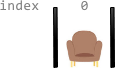
**Input:** corridor = "S"
**Output:** 0
**Explanation:** There is no way to divide the corridor because there will always be a section that does not have exactly two seats.
Constraints:
1
2
3
n == corridor.length
1 <= n <= 105
corridor[i] is either 'S' or 'P'.
1
2
3
4
5
6
7
8
9
10
11
12
13
14
15
16
17
18
19
20
21
22
23
24
25
26
27
28
29
30
31
32
33
34
35
36
37
38
39
40
41
42
43
44
45
46
47
48
49
50
51
52


class Solution:
    def numberOfWays(self, corridor: str) -> int:
        # Store 1000000007 in a variable for convenience
        MOD = 1_000_000_007

        # Cache the result of each sub-problem
        cache = [[-1] * 3 for _ in range(len(corridor))]

        # Count the number of ways to divide from "index" to the last index
        # with "seats" number of "S" in the current section
        def count(index, seats):
            # If we have reached the end of the corridor, then
            # the current section is valid only if "seats" is 2
            if index == len(corridor):
                return 1 if seats == 2 else 0

            # If we have already computed the result of this sub-problem,
            # then return the cached result
            if cache[index][seats] != -1:
                return cache[index][seats]

            # If the current section has exactly 2 "S"
            if seats == 2:
                # If the current element is "S", then we have to close the
                # section and start a new section from this index. Next index
                # will have one "S" in the current section
                if corridor[index] == "S":
                    result = count(index + 1, 1)
                else:
                    # If the current element is "P", then we have two options
                    # 1. Close the section and start a new section from this index
                    # 2. Keep growing the section
                    result = (count(index + 1, 0) + count(index + 1, 2)) % MOD
            else:
                # Keep growing the section. Increment "seats" if present
                # element is "S"
                if corridor[index] == "S":
                    result = count(index + 1, seats + 1)
                else:
                    result = count(index + 1, seats)

            # Memoize the result, and return it
            cache[index][seats] = result
            return cache[index][seats]

        # Call the count function
        return count(0, 0)