2043 Cyclically Rotating A Grid
2043 Cyclically Rotating A Grid
Cyclically Rotating a Grid 
You are given an m x n integer matrix grid, where m and n are both even integers, and an integer k.
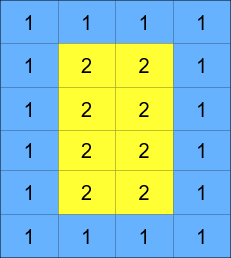
The matrix is composed of several layers, which is shown in the below image, where each color is its own layer:
A cyclic rotation of the matrix is done by cyclically rotating each layer in the matrix. To cyclically rotate a layer once, each element in the layer will take the place of the adjacent element in the counter-clockwise direction. An example rotation is shown below:
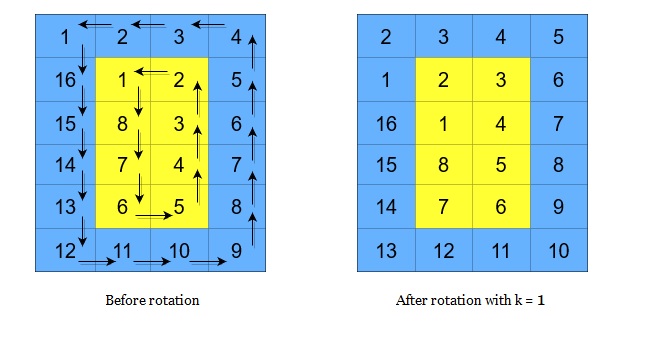
Return the matrix after applying *k *cyclic rotations to it.
Example 1:
1
2
3
4
5

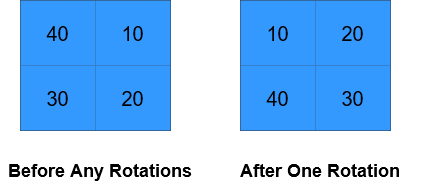
**Input:** grid = [[40,10],[30,20]], k = 1
**Output:** [[10,20],[40,30]]
**Explanation:** The figures above represent the grid at every state.
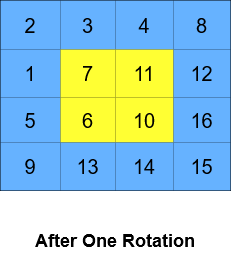
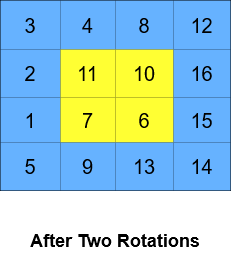
Example 2:
1
2
3
4
5

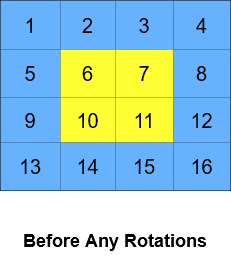
**Input:** grid = [[1,2,3,4],[5,6,7,8],[9,10,11,12],[13,14,15,16]], k = 2
**Output:** [[3,4,8,12],[2,11,10,16],[1,7,6,15],[5,9,13,14]]
**Explanation:** The figures above represent the grid at every state.
Constraints:
1
2
3
4
5
6
m == grid.length
n == grid[i].length
2 <= m, n <= 50
Both m and n are **even** integers.
1 <= grid[i][j] <= 5000
1 <= k <= 109
1
2
3
4
5
6
7
8
9
10
11
12
13
14
15
16
17
18
19
20
21
22
23
24
25
26
27
28
29
30
31
32
33
34
35
36
37
38
39
40
41
42
43
44
45
46
47


impl Solution {
    pub fn rotate_grid(mut grid: Vec<Vec<i32>>, k: i32) -> Vec<Vec<i32>> {
        let m = grid.len();
        let n = grid[0].len();
        let nlayer = (m / 2).min(n / 2);   // level count
        let k = k as usize;
        // enumerate each layer counterclockwise starting from the top-left corner
        for layer in 0..nlayer {
            let mut r = Vec::new();
            let mut c = Vec::new();
            let mut val = Vec::new();   // each element's row index, column index, and value
            for i in layer..m - layer - 1 {   // left
                r.push(i);
                c.push(layer);
                val.push(grid[i][layer]);
            }
            for j in layer..n - layer - 1 {   // down
                r.push(m - layer - 1);
                c.push(j);
                val.push(grid[m - layer - 1][j]);
            }
            for i in (layer + 1..=m - layer - 1).rev() {   // right
                r.push(i);
                c.push(n - layer - 1);
                val.push(grid[i][n - layer - 1]);
            }
            for j in (layer + 1..=n - layer - 1).rev() {   // up
                r.push(layer);
                c.push(j);
                val.push(grid[layer][j]);
            }
            let total = val.len();   // total number of elements in each layer
            let kk = k % total;   // equivalent number of rotations
            // find the value at each index after rotation
            for i in 0..total {
                let idx = (i + total - kk) % total;   // the index corresponding to the value after rotation
                grid[r[i]][c[i]] = val[idx];
            }
        }
        grid
    }
}
This post is licensed under CC BY 4.0 by the author.