1845 Largest Submatrix With Rearrangements
1845 Largest Submatrix With Rearrangements
Largest Submatrix With Rearrangements 
You are given a binary matrix matrix of size m x n, and you are allowed to rearrange the columns of the matrix in any order.
Return the area of the largest submatrix within *matrix where every element of the submatrix is 1 after reordering the columns optimally.*
Example 1:
1
2
3
4
5
6

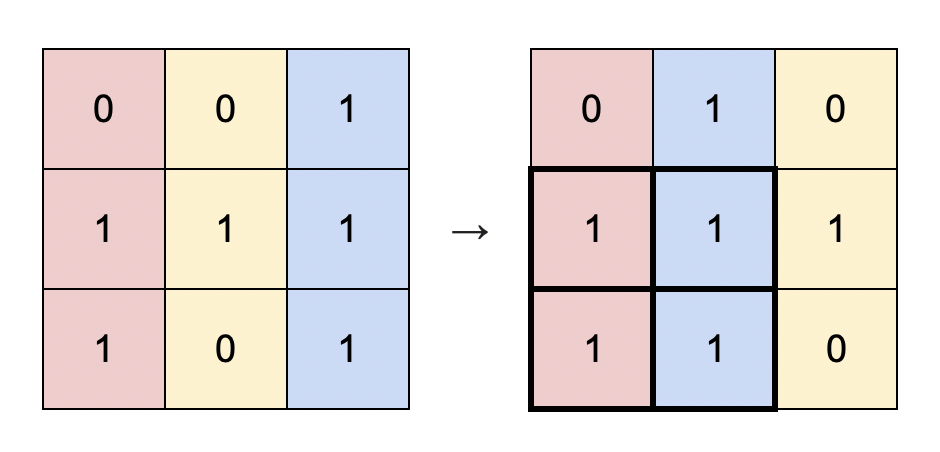
**Input:** matrix = [[0,0,1],[1,1,1],[1,0,1]]
**Output:** 4
**Explanation:** You can rearrange the columns as shown above.
The largest submatrix of 1s, in bold, has an area of 4.
Example 2:

1
2
3
4
5
6

**Input:** matrix = [[1,0,1,0,1]]
**Output:** 3
**Explanation:** You can rearrange the columns as shown above.
The largest submatrix of 1s, in bold, has an area of 3.
Example 3:
1
2
3
4
5

**Input:** matrix = [[1,1,0],[1,0,1]]
**Output:** 2
**Explanation:** Notice that you must rearrange entire columns, and there is no way to make a submatrix of 1s larger than an area of 2.
Constraints:
1
2
3
4
m == matrix.length
n == matrix[i].length
1 <= m * n <= 105
matrix[i][j] is either 0 or 1.
1
2
3
4
5
6
7
8
9
10
11
12
13
14
15
16
17
18
19
20
21
22
23
24
25


class Solution:
    def largestSubmatrix(self, matrix: List[List[int]]) -> int:
        m = len(matrix)
        n = len(matrix[0])
        prev_row = [0] * n
        ans = 0

        for row in range(m):
            curr_row = matrix[row][:]
            for col in range(n):
                if curr_row[col] != 0:
                    curr_row[col] += prev_row[col]

            sorted_row = sorted(curr_row, reverse=True)
            for i in range(n):
                ans = max(ans, sorted_row[i] * (i + 1))

            prev_row = curr_row

        return ans
This post is licensed under CC BY 4.0 by the author.