1658 Minimum Swaps To Arrange A Binary Grid
1658 Minimum Swaps To Arrange A Binary Grid
Minimum Swaps to Arrange a Binary Grid 
Given an n x n binary grid, in one step you can choose two adjacent rows of the grid and swap them.
A grid is said to be valid if all the cells above the main diagonal are zeros.
Return the minimum number of steps needed to make the grid valid, or -1 if the grid cannot be valid.
The main diagonal of a grid is the diagonal that starts at cell (1, 1) and ends at cell (n, n).
Example 1:

1
2
3
4

**Input:** grid = [[0,0,1],[1,1,0],[1,0,0]]
**Output:** 3
Example 2:
1
2
3
4
5

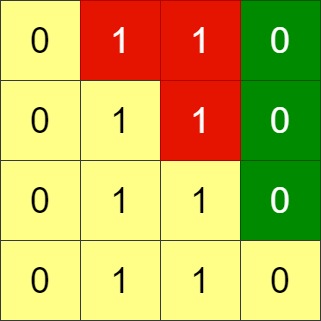
**Input:** grid = [[0,1,1,0],[0,1,1,0],[0,1,1,0],[0,1,1,0]]
**Output:** -1
**Explanation:** All rows are similar, swaps have no effect on the grid.
Example 3:
1
2
3
4

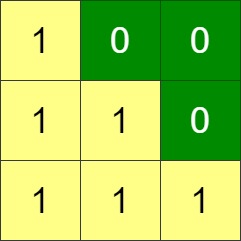
**Input:** grid = [[1,0,0],[1,1,0],[1,1,1]]
**Output:** 0
Constraints:
1
2
3
n == grid.length == grid[i].length
1 <= n <= 200
grid[i][j] is either 0 or 1
1
2
3
4
5
6
7
8
9
10
11
12
13
14
15
16
17
18
19
20
21
22
23
24
25
26
27
28
29
30
31
32
33
34
35
36
37
38
39
40
41
42
43
44
45
46
47
48
49
50
51
52
53
54
55
56


impl Solution {
    pub fn min_swaps(grid: Vec<Vec<i32>>) -> i32 {
        let n = grid.len();

        // Precompute trailing zeros for each row
        let mut trailing_zeros: Vec<usize> = vec![0; n];
        for i in 0..n {
            let mut count = 0;
            for j in (0..n).rev() {
                if grid[i][j] == 0 {
                    count += 1;
                } else {
                    break;
                }
            }
            trailing_zeros[i] = count;
        }

        // Row i needs at least (n - 1 - i) trailing zeros
        let mut swaps = 0;
        let mut rows = trailing_zeros.clone();

        for i in 0..n {
            let needed = n - 1 - i;

            // Find the closest row at or below i that satisfies the requirement
            let mut found = None;
            for j in i..n {
                if rows[j] >= needed {
                    found = Some(j);
                    break;
                }
            }

            match found {
                None => return -1,
                Some(j) => {
                    // Bubble row j up to position i
                    swaps += (j - i) as i32;
                    // Shift rows down
                    for k in (i+1..=j).rev() {
                        rows.swap(k, k-1);
                    }
                }
            }
        }

        swaps
    }
}
This post is licensed under CC BY 4.0 by the author.