1628 Count Submatrices With All Ones
1628 Count Submatrices With All Ones
Count Submatrices With All Ones 
Given an m x n binary matrix mat, return the number of submatrices that have all ones.
Example 1:
1
2
3
4
5
6
7
8
9
10
11

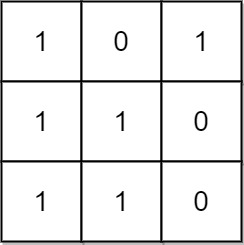
**Input:** mat = [[1,0,1],[1,1,0],[1,1,0]]
**Output:** 13
**Explanation:**
There are 6 rectangles of side 1x1.
There are 2 rectangles of side 1x2.
There are 3 rectangles of side 2x1.
There is 1 rectangle of side 2x2.
There is 1 rectangle of side 3x1.
Total number of rectangles = 6 + 2 + 3 + 1 + 1 = 13.
Example 2:
1
2
3
4
5
6
7
8
9
10
11
12
13

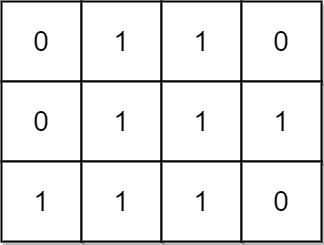
**Input:** mat = [[0,1,1,0],[0,1,1,1],[1,1,1,0]]
**Output:** 24
**Explanation:**
There are 8 rectangles of side 1x1.
There are 5 rectangles of side 1x2.
There are 2 rectangles of side 1x3.
There are 4 rectangles of side 2x1.
There are 2 rectangles of side 2x2.
There are 2 rectangles of side 3x1.
There is 1 rectangle of side 3x2.
Total number of rectangles = 8 + 5 + 2 + 4 + 2 + 2 + 1 = 24.
Constraints:
1
2
1 <= m, n <= 150
mat[i][j] is either 0 or 1.
1
2
3
4
5
6
7
8
9
10
11
12
13
14
15
16
17
18
19
20
21
22
23
24
25
26
27
28
29
30
31
32
33
34
35
36
37
38
39
40
41
42
43
44
45
46
47
48
49
50
51
52
53
54
55
56
57
58
59
60
61
62
63
64
65
66
67
68
69


class Solution:
    def numSubmat(self, mat: List[List[int]]) -> int:
        """
            a rectangle is x + 1, y or y + 1, x
            if 1,1 is present then we move x +1 or y + 1
            if true then we move x + 1, y + 1
            at any point we have 3 possibilities of rectangles
            row | col or row,col
            so at any point
            T[i,j] = 1 + T[i + 1, j] -> this is row based rectangle
            S[i,j] = 1 + S[i, j+ 1] -> this is col based
            say we have a r row and c col
            then number of rectangles starting at i,j is row * col
            as size 1*1, then 1*2 ..1*n ( of row len 1)
            then size 2*1, 2*2 .... 2*n (of row length 2)
            ignore below ---->

            Q[i,j] = 1 +  max(Q[i+1,j], min(S[i+1,j], S[i,j])) -> this is both row and col based

            what if the reactangle is 2*n
            2*2 we can could as a reactangle
            we cannot count normally 2*n ,
            what if Q is not needed,
            We just have a 1*2 and 2*1 and next cell is 2*1


        """
        rows = [row[:] for row in mat]
        cols = [row[:] for row in mat]


        for r in range(len(rows)-1, -1, -1):
            for c in range(len(rows[0])-1, -1, -1):
                if r + 1 < len(rows) and mat[r][c] == 1:
                    rows[r][c] = rows[r+1][c] + 1
                if c + 1 < len(rows[0]) and mat[r][c] == 1:
                    cols[r][c] = cols[r][c+1] + 1

        R, C = len(mat), len(mat[0])
        res = 0
        # count submatrices
        for r in range(R):
            for c in range(C):
                if mat[r][c] == 1:
                    min_width = float("inf")
                    for k in range(rows[r][c]):  # extend downward
                        min_width = min(min_width, cols[r+k][c])
                        res += min_width
        return res

        res = 0
        print(rows, cols)
        for r in range(len(rows)-1, -1, -1):
            for c in range(len(rows[0])-1, -1, -1):
                res += rows[r][c] * cols[r][c]
        return res
This post is licensed under CC BY 4.0 by the author.