1395 Minimum Time Visiting All Points
1395 Minimum Time Visiting All Points
Minimum Time Visiting All Points 
On a 2D plane, there are n points with integer coordinates points[i] = [xi, yi]. Return *the minimum time in seconds to visit all the points in the order given by *points.
You can move according to these rules:
1
2
3
4
5
6
7
8
In 1 second, you can either:

	move vertically by one unit,
	move horizontally by one unit, or
	move diagonally sqrt(2) units (in other words, move one unit vertically then one unit horizontally in 1 second).

You have to visit the points in the same order as they appear in the array.
You are allowed to pass through points that appear later in the order, but these do not count as visits.
Example 1:
1
2
3
4
5
6
7

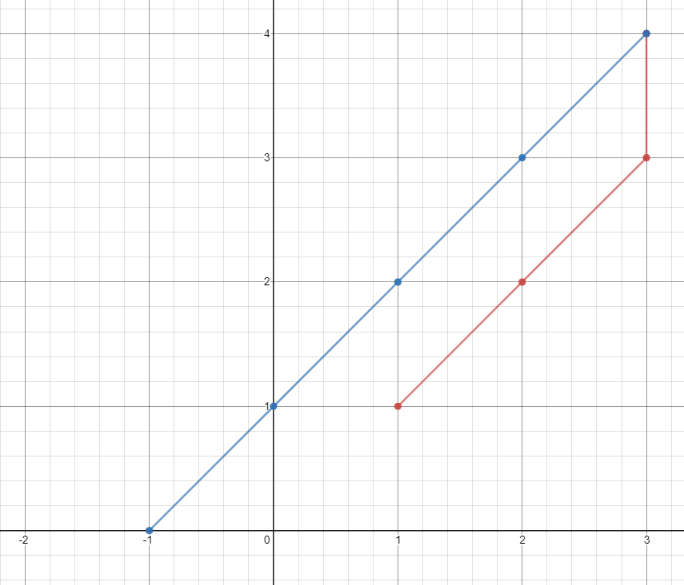
**Input:** points = [[1,1],[3,4],[-1,0]]
**Output:** 7
**Explanation: **One optimal path is **[1,1]** -> [2,2] -> [3,3] -> **[3,4] **-> [2,3] -> [1,2] -> [0,1] -> **[-1,0]**
Time from [1,1] to [3,4] = 3 seconds
Time from [3,4] to [-1,0] = 4 seconds
Total time = 7 seconds
Example 2:
1
2
3
4

**Input:** points = [[3,2],[-2,2]]
**Output:** 5
Constraints:
1
2
3
4
points.length == n
1 <= n <= 100
points[i].length == 2
-1000 <= points[i][0], points[i][1] <= 1000
1
2
3
4
5
6
7
8
9
10
11
12
13
14
15
16
17
18
19
20
21
22
23
24
25
26
27
28
29
30
31


class Solution:
    def minTimeToVisitAllPoints(self, points: List[List[int]]) -> int:
        # always move diagnoally till you reach x ot y
        # check if x1 - x2 is smaller or y1 - y2
        # then take min(abs(x1-x2) , abs(y1-y2)) as k, this is diag movemeny
        # then add or substract k to each and do abs diff with x2 and y2 , then take max as other value will be xero
        res = 0

        for (i, k) in enumerate(points):
            if i == len(points) - 1:
                break
            x1 = k[0]
            y1 = k[1]
            x2 = points[i+1][0]
            y2 = points[i+1][1]
            m = min(abs(x1-x2) , abs(y1-y2))
            res += m
            #print(res)
            if abs(x1-x2) < abs(y1-y2):
                # means after k steps x1 == x2
                res += min(abs(y1 + m - y2), abs(y1 - m - y2))
            else:
                res += min(abs(x1 + m - x2), abs(x1 - m - x2))

        return res
This post is licensed under CC BY 4.0 by the author.