1311 Largest Magic Square
1311 Largest Magic Square
Largest Magic Square 
A k x k magic square is a k x k grid filled with integers such that every row sum, every column sum, and both diagonal sums are all equal. The integers in the magic square do not have to be distinct. Every 1 x 1 grid is trivially a magic square.
Given an m x n integer grid, return the size (i.e., the side length *k) of the largest magic square that can be found within this grid*.
Example 1:
1
2
3
4
5
6
7
8
9

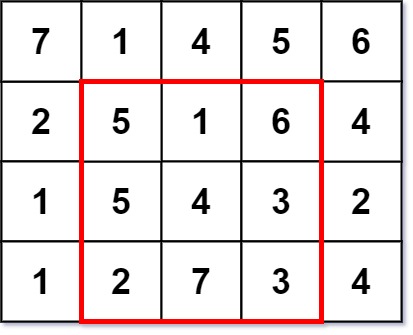
**Input:** grid = [[7,1,4,5,6],[2,5,1,6,4],[1,5,4,3,2],[1,2,7,3,4]]
**Output:** 3
**Explanation:** The largest magic square has a size of 3.
Every row sum, column sum, and diagonal sum of this magic square is equal to 12.
- Row sums: 5+1+6 = 5+4+3 = 2+7+3 = 12
- Column sums: 5+5+2 = 1+4+7 = 6+3+3 = 12
- Diagonal sums: 5+4+3 = 6+4+2 = 12
Example 2:
1
2
3
4

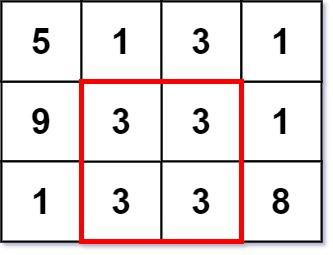
**Input:** grid = [[5,1,3,1],[9,3,3,1],[1,3,3,8]]
**Output:** 2
Constraints:
1
2
3
4
m == grid.length
n == grid[i].length
1 <= m, n <= 50
1 <= grid[i][j] <= 106
1
2
3
4
5
6
7
8
9
10
11
12
13
14
15
16
17
18
19
20
21
22
23
24
25
26
27
28
29
30
31
32
33
34
35
36
37
38
39
40
41
42
43
44
45
46
47
48
49
50
51
52
53
54
55
56
57
58
59
60
61
62
63
64
65
66
67
68
69


class Solution:
    def largestMagicSquare(self, grid: List[List[int]]) -> int:
        m, n = len(grid), len(grid[0])

        # prefix sum of each row
        rowsum = [[0] * n for _ in range(m)]
        for i in range(m):
            rowsum[i][0] = grid[i][0]
            for j in range(1, n):
                rowsum[i][j] = rowsum[i][j - 1] + grid[i][j]

        # prefix sum of each column
        colsum = [[0] * n for _ in range(m)]
        for j in range(n):
            colsum[0][j] = grid[0][j]
            for i in range(1, m):
                colsum[i][j] = colsum[i - 1][j] + grid[i][j]

        # enumerate edge lengths from largest to smallest
        for edge in range(min(m, n), 1, -1):
            # enumerate the top-left corner position (i,j) of the square
            for i in range(m - edge + 1):
                for j in range(n - edge + 1):
                    # the value for each row, column, and diagonal should be calculated (using the first row as a sample)
                    stdsum = rowsum[i][j + edge - 1] - (
                        0 if j == 0 else rowsum[i][j - 1]
                    )
                    check = True
                    # enumerate each row and directly compute the sum using prefix sums
                    # since we have already used the first line as a sample, we can skip the first line here.
                    for ii in range(i + 1, i + edge):
                        if (
                            rowsum[ii][j + edge - 1]
                            - (0 if j == 0 else rowsum[ii][j - 1])
                            != stdsum
                        ):
                            check = False
                            break
                    if not check:
                        continue

                    # enumerate each column and directly calculate the sum using prefix sums
                    for jj in range(j, j + edge):
                        if (
                            colsum[i + edge - 1][jj]
                            - (0 if i == 0 else colsum[i - 1][jj])
                            != stdsum
                        ):
                            check = False
                            break
                    if not check:
                        continue

                    # d1 and d2 represent the sums of the two diagonals respectively.
                    # here d denotes diagonal
                    d1 = d2 = 0
                    # sum directly by traversing without using the prefix sum.
                    for k in range(edge):
                        d1 += grid[i + k][j + k]
                        d2 += grid[i + k][j + edge - 1 - k]
                    if d1 == stdsum and d2 == stdsum:
                        return edge

        return 1
This post is licensed under CC BY 4.0 by the author.