1207 Delete Nodes And Return Forest
1207 Delete Nodes And Return Forest
Delete Nodes And Return Forest 
Given the root of a binary tree, each node in the tree has a distinct value.
After deleting all nodes with a value in to_delete, we are left with a forest (a disjoint union of trees).
Return the roots of the trees in the remaining forest. You may return the result in any order.
Example 1:
1
2
3
4

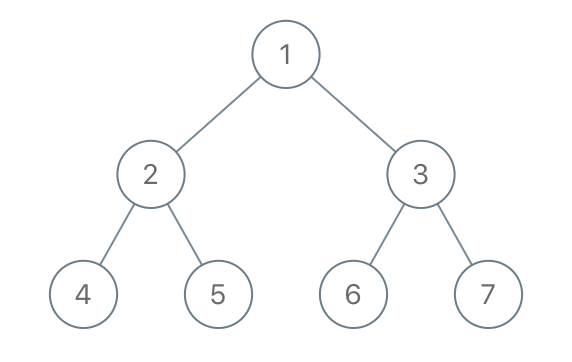
**Input:** root = [1,2,3,4,5,6,7], to_delete = [3,5]
**Output:** [[1,2,null,4],[6],[7]]
Example 2:
1
2
3
4

**Input:** root = [1,2,4,null,3], to_delete = [3]
**Output:** [[1,2,4]]
Constraints:
1
2
3
4
The number of nodes in the given tree is at most 1000.
Each node has a distinct value between 1 and 1000.
to_delete.length <= 1000
to_delete contains distinct values between 1 and 1000.
1
2
3
4
5
6
7
8
9
10
11
12
13
14
15
16
17
18
19
20
21
22
23
24
25
26
27
28
29
30
31
32
33
34
35
36
37
38


# Definition for a binary tree node.
# class TreeNode:
#     def __init__(self, val=0, left=None, right=None):
#         self.val = val
#         self.left = left
#         self.right = right
class Solution:
    def delNodes(self, root: Optional[TreeNode], to_delete: List[int]) -> List[TreeNode]:
        result = []
        parent = []
        def dfs(root, to_delete, start):
            if root == None:
                return
            if start and root.val not in to_delete:
                result.append(root)
            if root.val in to_delete:
                dfs(root.left, to_delete,True)
                dfs(root.right, to_delete,True)
                parent.append(root)
            else:
                dfs(root.left, to_delete,False)
                dfs(root.right, to_delete,False)
            if root.left in parent:
                root.left = None
            if root.right in parent:
                root.right = None

        dfs(root, to_delete, False)
        if root not in parent:
            result.append(root)
        return result
This post is licensed under CC BY 4.0 by the author.